
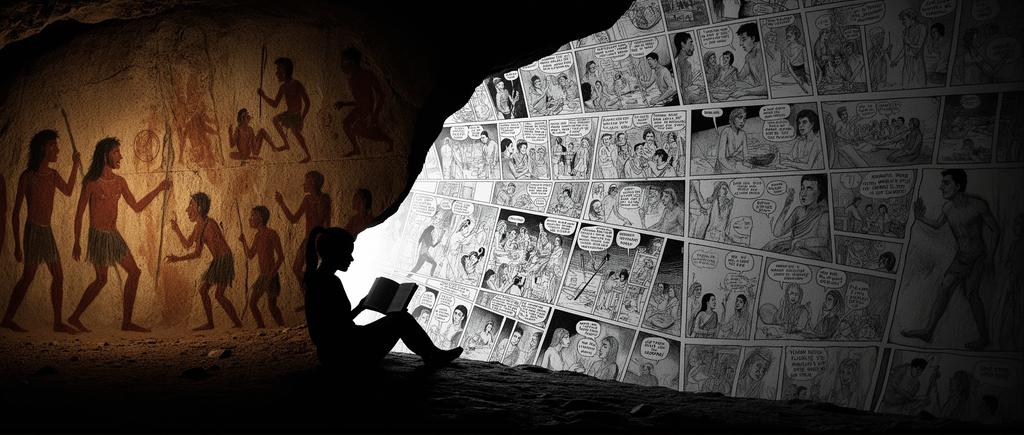
Other than the spoken word, visual art is the oldest form of storytelling. We see this on cave walls and inside tombs and pyramids – pictures telling stories of heroism, tragedy, and joy. From the Lascaux caves to Egyptian hieroglyphics, humanity has always understood that images carry narrative power that transcends language barriers and speaks directly to our emotions.
The graphic novel is an artform that continues these oldest traditions. While some view it as a medium for children, the graphic novel has evolved into a sophisticated medium all its own. Many independent artists and writers are joining forces to produce content that rivals cinema and conventional novels in emotional depth and storytelling complexity. Works like Maus, Persepolis, and Sandman have earned literary accolades and demonstrated that sequential art can tackle the most profound themes of human existence.
The Space Between: What Makes Graphic Novels Unique
The graphic novel can place us in the center of the story much like a movie can. But it provides emotional value in its panels that cinema is unable to provide. Unlike film, where the director controls the pacing through editing, the graphic novel places temporal power in the reader’s hands. You can linger on a single panel for minutes, absorbing the details of an expression, the weight of a silence, the texture of a moment. You can race through action sequences or pause to study background details that enrich the narrative. This participatory pacing creates a unique intimacy between reader and story.
The “gutter” – the space between panels – is where graphic novels perform their most remarkable magic. In that white space, the reader’s imagination activates, bridging moments, filling in motion, and completing the narrative circuit. This collaboration between creator and consumer doesn’t exist in film, where every second is filled, or in prose, where the author controls the rhythm entirely. The gutter demands reader participation, making the experience inherently more personal and immersive.
The Unshowable Made Visible
Graphic novels can show us scenes that words cannot describe. Abstract concepts, impossible geometries, dream logic, and psychological states find perfect expression in the medium. In prose, describing a surreal landscape or a character’s fractured mental state requires paragraphs of exposition. In film, such sequences often feel jarring or confusing. But in sequential art, the impossible can unfold naturally, panel by panel, allowing readers to absorb and process the fantastic at their own pace.
Consider how graphic novels handle memory. Through visual metaphor, shifting art styles, and non-linear panel layouts, they can render the fragmented, sensory nature of recollection in ways that feel authentic to how memory actually works. The medium can collapse time, show multiple perspectives simultaneously, or visualize internal monologue without the awkwardness of voiceover.
The Democratization of Storytelling
Perhaps one of graphic novels’ greatest strengths is their accessibility to creators. While filmmaking requires massive budgets, crews, and distribution networks, and traditional publishing increasingly favors established names, graphic novels remain a medium where individual vision can flourish. A single creator can write, illustrate, letter, and publish their work with minimal resources. This has fostered a renaissance of diverse voices telling stories that mainstream media often ignores.
Independent creators are exploring narratives about mental health, identity, historical events, and personal memoir with unflinching honesty. The medium’s low barrier to entry means that stories from marginalized communities, unconventional perspectives, and experimental approaches can find audiences without gatekeeper approval.
The Complete Experience
And yet, graphic novels can make us feel the same emotions invoked by the storytelling from books, stage, and screen. They combine the literary depth of novels, the visual impact of cinema, and the theatrical intimacy of watching a performance unfold before your eyes. The best graphic novels create what cartoonist Will Eisner called “sequential art” – a synthesis where words and images don’t merely complement each other but become inseparable, each doing what the other cannot.
When a character’s dialogue is paired with their visual expression, when the panel layout accelerates to match rising tension, when color palettes shift to reflect emotional states, the graphic novel achieves something singular: it engages multiple parts of our brain simultaneously. We read, we see, we imagine, we feel – all at once.
Conclusion
The graphic novel stands as proof that storytelling continues to evolve while honoring its ancient roots. It reminds us that humans are visual creatures who have always used images to make sense of our world. In an era of infinite content and shrinking attention spans, the graphic novel offers something precious: a deliberate, participatory, deeply personal storytelling experience.
Whether you’re discovering the medium for the first time or returning to it with fresh eyes, graphic novels offer a unique covenant between creator and reader. They ask you to look, to imagine, to participate – and in return, they offer worlds, emotions, and perspectives that no other medium can quite capture.
What graphic novels have moved you in ways other media couldn’t? The medium continues to evolve, and its best works remind us that sometimes the most powerful stories are the ones we help create in the space between the panels.