

In the 1660s, Isaac Newton locked himself in a shadowy room with a single shaft of sunlight and a prism. What happened next rewrote humanity’s understanding of light—until it didn’t. Newton’s rainbow revealed seven colors hidden in white light: red, orange, yellow, green, blue, indigo, violet. A neat, orderly spectrum. But here’s the problem: reality doesn’t play by those rules.
Color isn’t physics. It’s an illusion.
Johann Goethe, the 19th-century poet-scientist, called Newton’s teachings false. Why? Because color isn’t just light—it’s us. Your brain, right now, is stitching together a reality it’s inventing. Every hue you see is a hallucination. Your eyes? They’re mere sensors, picking up wavelengths between 380-790 nanometers—tiny slivers of the electromagnetic storm raging around you. But what your brain does with those signals is where the magic turns to smoke.
Imagine this: When you say “red,” you’re describing a wavelength of ~700nm. But how do you know your red isn’t someone else’s green? There’s no way to tell. We’re all locked in our own private universe of color, trained from childhood to point at a fire truck and chant, “Red!”
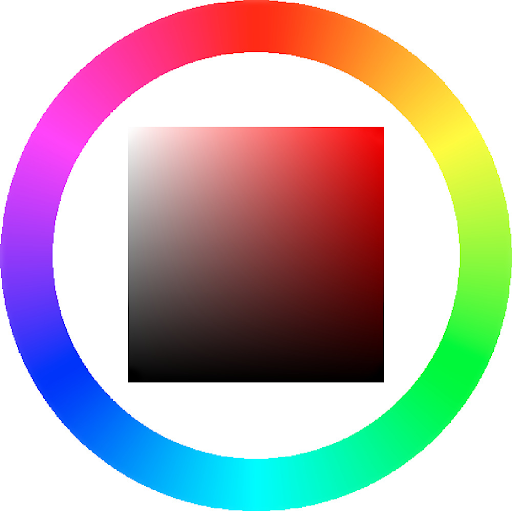
And here’s the kicker: The visible spectrum isn’t a rainbow or a circle. It’s a straight line—from infrared (warmth without light) to ultraviolet (light without warmth). Yet we as artists, including myself, use a color wheel to help us choose our colors. So, if light is a range of electromagnetic frequencies, how does red bleed into violet when physics says it can’t? Your brain, desperate for order, stitches the ends together like a child taping the edges of a rainbow. The wheel is a lie. But, a beautiful, necessary lie.
Some of us see deeper into the illusion. Tetrachromats—individuals with a rare genetic quirk—perceive 100 million hues, a kaleidoscope the rest of us can’t fathom. Bees dance in ultraviolet, seeing patterns on flowers we’ll never spot. Meanwhile, most mammals live in a washed-out world of blues and yellows. Color is not equal. It’s a rigged game.
So what’s the takeaway for all of us artists? Our palette isn’t just pigment. It’s neurology. Red isn’t “passionate” because of physics—it’s passionate because our brain maps it to danger, desire, and the thudding of your own heart. Blue isn’t “calm” because of wavelengths—it’s the color of distance, the sky that never touches the earth.
Next time you paint, remember: You’re not mixing colors. You’re hacking into our brains.
As Goethe might say: “The mystery of color is the mystery of yourself.” Create bravely.”
